PLATO Hand: Shaping Contact Behavior with Fingernails for Precise Manipulation

Accepted to IEEE Robotics and Automation Letters (RA-L), May 2026

Abstract

We present the PLATO Hand, a dexterous robotic hand with a hybrid fingertip that combines a rigid fingernail, an embedded distal phalanx, and a compliant pulp. Instead of treating the fingertip as a passive soft pad, the design mechanically shapes how contact is initiated, supported, and transmitted during manipulation. We develop a strain-energy-based bending-indentation model that explains how material stiffness and contact geometry partition fingertip deformation between global bending and local indentation. Experiments show improved pinch stability, more observable contact-induced force variations, and reliable execution of edge-sensitive tasks such as paper singulation, card picking, and orange peeling. Together, these results show that coupling a structured contact interface with a force-motion-transparent finger mechanism provides a principled approach to precise manipulation.

Manipulation Demo

Contact/Collision Compliance

Passive compliance through backdrivable quasi-direct drive actuators enables safe and adaptive responses to unexpected contact forces.

Flicking Object

High-acceleration strikes achieved through low gear ratios and minimal reflected inertia generate rapid motions to propel objects with controlled impulse.

Texture Sensing

High force sensitivity from fingernail sensors identifies surface properties during tactile exploration and probing interactions.

Catching Object

Fast actuation and low-latency communication enable precise timing and trajectory-based grasping to intercept moving objects.

Edge Insertion Manipulation

Sharp fingernails puncture and manipulate soft surfaces with controlled penetration forces for orange peeling tasks.

Contact-rich Manipulation

Precision tasks such as coin picking combine proprioceptive force control with fingernail sensing for simultaneous contact detection and force regulation.

Key Findings

The PLATO Hand uses the fingernail as a structural contact-shaping element, not just as a rigid tip for picking thin objects. The fingernail and embedded distal phalanx suppress global fingertip bending, while the compliant pulp remains available for local indentation and stable contact formation.

Stable Pinching

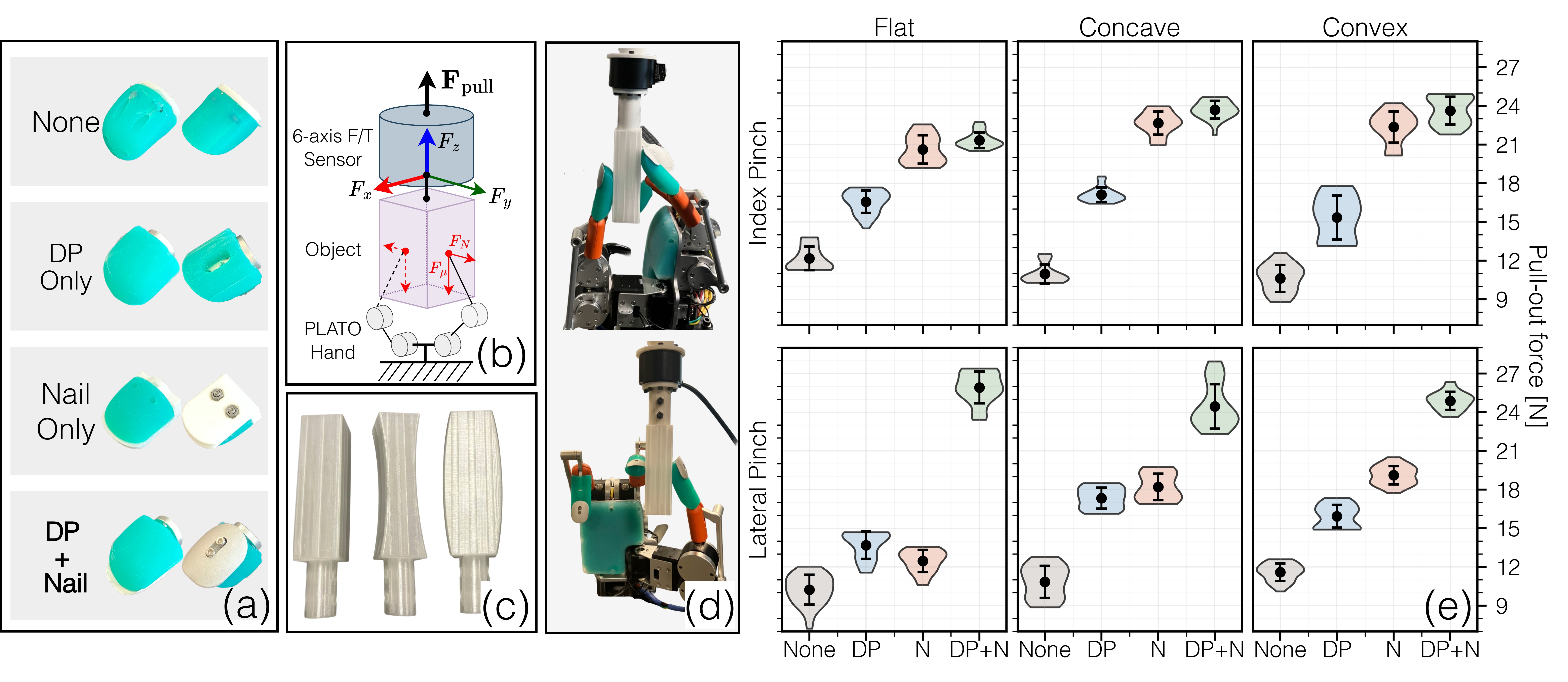
In lateral pinch, the combined distal phalanx and fingernail design improves pull-out force by 108% over the fingernail-only fingertip on flat objects, and by 153%, 126%, and 116% over the pulp-only fingertip on flat, concave, and convex objects.

Force Observability

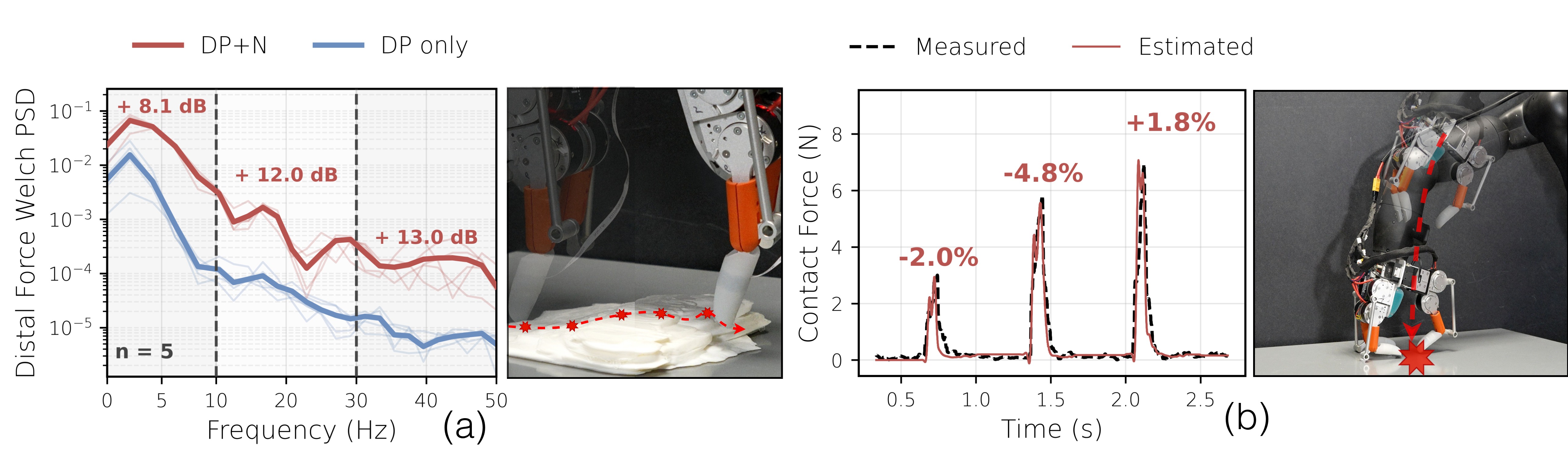
Nail-mediated dorsal contact transmits contact-induced force variations more clearly through the fingertip, helping proprioceptive force estimates track rapid impacts and texture interactions.

Edge-Sensitive Tasks

With the fingernail, PLATO completes paper singulation, coin picking, card picking, card flipping, lid opening, and orange peeling trials that often fail when the fingertip only has the embedded distal phalanx.

Design Overview

The PLATO Hand combines a hybrid rigid-soft fingertip with quasi-direct drive (QDD) actuators and a linkage mechanism. The fingernail not only increases flexural rigidity at the fingertip, stabilizing the soft pulp to enlarge contact area for adaptive and stable grasping, but also provides a rigid and concentrated contact point for transparent force transmission. Combined with high-bandwidth proprioceptive actuation, the PLATO Hand achieves precise dexterous manipulation across a variety of challenging tasks.
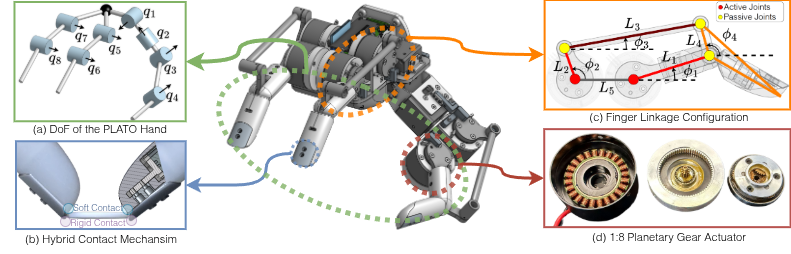
PLATO Hand Design

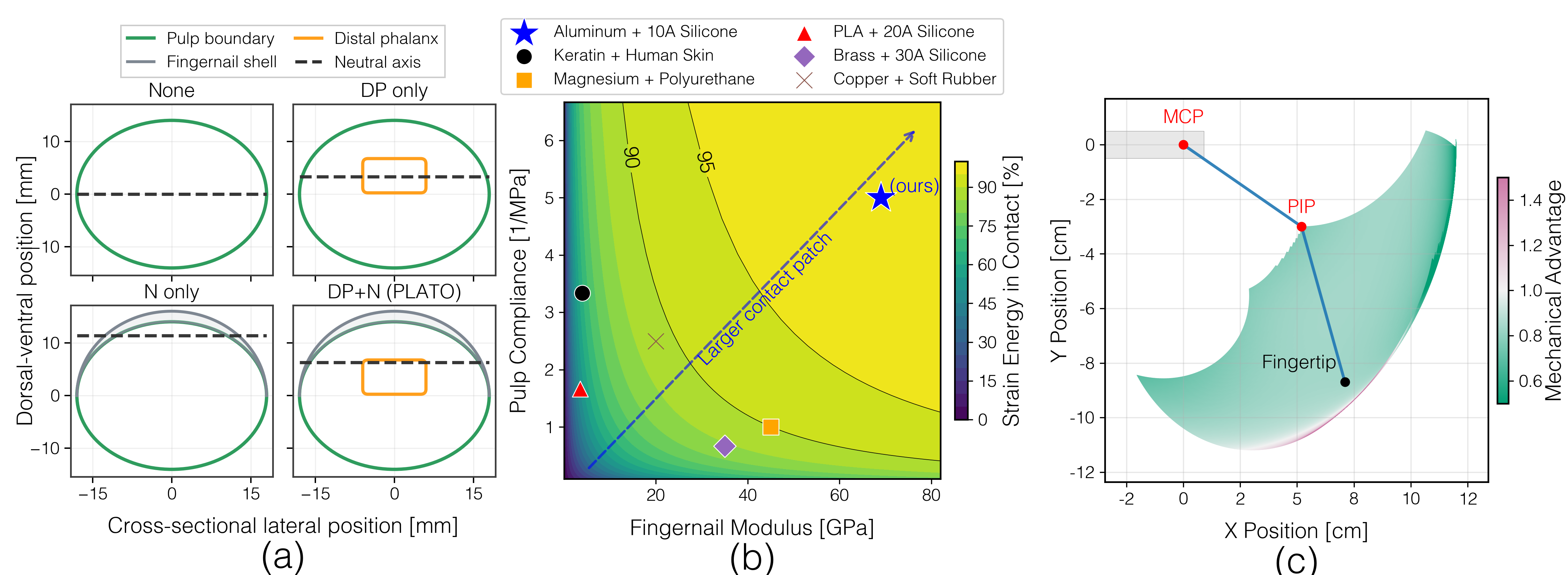
The PLATO Hand employs a biomimetic fingertip that combines a rigid fingernail with a compliant, deformable fingerpulp to structure local contact mechanics. This hybrid construction separates local contact compliance from global fingertip stiffness, allowing deformation during contact to be shaped independently of overall rigidity. The bending-indentation model explains this design goal: the fingertip should resist folding around the object while still allowing the pulp to indent locally and form a stable contact patch.
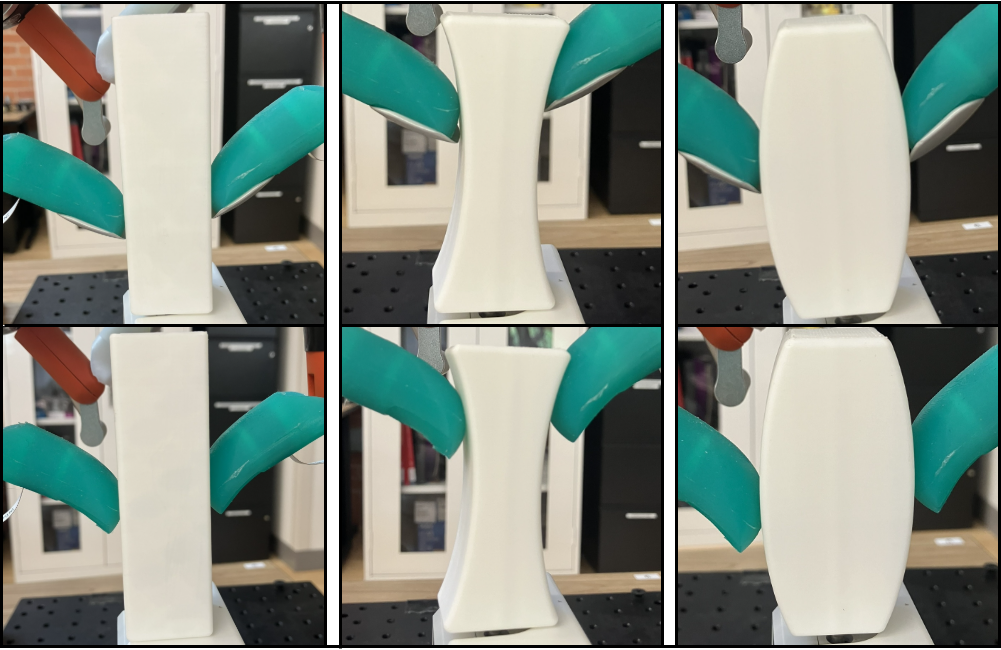
Fingertip With vs Without Fingernail

The fingernail improves pinching stability by stabilizing contact during pullout. Tests on flat, concave, and convex surfaces showed that fingertips with a rigid fingernail (top) consistently achieved higher pullout forces than fingertips without one (bottom). The fingernail prevents the fingertip from bending by redirecting strain energy into local indentation to its pulp, which helps maintain stable contact with the object. This effect is especially noticeable on curved surfaces and becomes even more important when the fingertip pulp is softer.

The PLATO Hand is able to achieve most tasks in the Grasp Taxonomy using three fingers; the inclusion of rigid fingernails extends its capabilities for precise manipulation tasks.
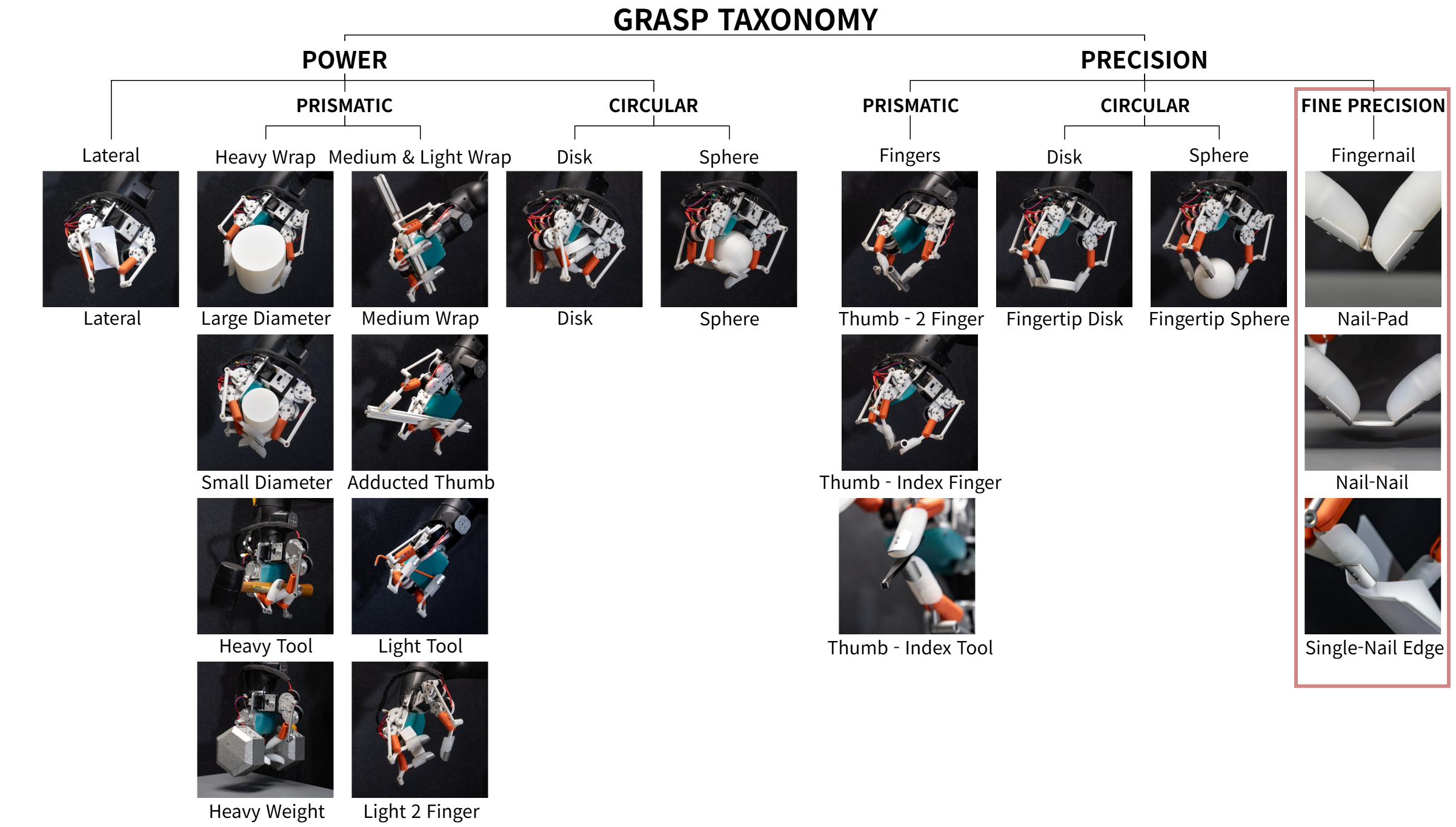
Manipulation Taxonomy

Technical Details

Design Validation

The fingertip design is validated through an energy-based bending-indentation analysis and linkage workspace characterization. The fingernail and distal phalanx shift the neutral axis and increase effective bending rigidity, which concentrates deformation into local pulp indentation rather than global fingertip bending. The optimized linkage also maintains a useful fingertip workspace while reducing mechanical-advantage variation for more consistent force transmission.

Energy-based fingertip design validation and linkage workspace characterization

Pull-Out Evaluation

To isolate how fingertip structure changes grasp stability, we compared four fingertip architectures: pulp-only, distal-phalanx-only, fingernail-only, and the combined distal phalanx plus fingernail design. Pull-out tests were performed on flat, concave, and convex objects under index-pinch and lateral-pinch configurations. The combined design produced the strongest and most consistent lateral-pinch performance across object geometries.

Pull-out evaluation across fingertip architectures and object geometries

Dorsal-Contact Force Transmission

The rigid fingernail also improves how contact-induced force variations propagate through the fingertip. During texture tracing, the combined fingertip transmits higher spectral energy than the distal-phalanx-only fingertip. During repeated dorsal impacts, proprioceptive force estimates derived from motor current closely track distal force-torque measurements, showing that nail-mediated contact remains observable through the low-impedance finger mechanism.

Dorsal-contact force transmission and proprioceptive force estimation

BibTeX

@article{kang2026platohand,
  author    = {Kang, Dong Ho and Kim, Aaron and Seo, Mingyo and Yokoyama, Kazuto and Narita, Tetsuya and Sentis, Luis},
  title     = {PLATO Hand: Shaping Contact Behavior with Fingernails for Precise Manipulation},
  journal   = {IEEE Robotics and Automation Letters},
  year      = {2026},
  note      = {Accepted May 2026},
}